
Youth PACT
Welcome to our Youth PACT page!
On this page you will find information all about Youth PACT and the importance of listening to children and young people in safeguarding work.
You can find also find all the information on this page on our useful information sheet HERE.
Scroll to the bottom of this page to find useful resources.
If you are part of a wider organisation, you are welcome to use this content to support your own work. We also have two training films that are available to partners to use. To get in touch regarding the films or the content, please contact us at vru@hampshire.police.uk.
What is a Youth PACT?
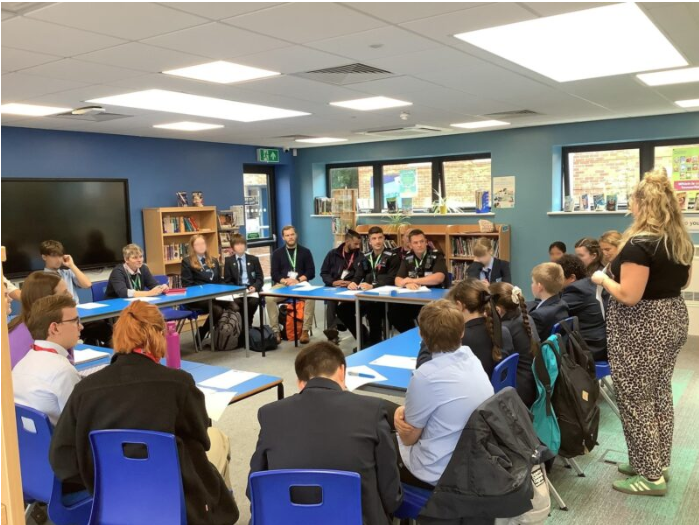
PACT stands for Police and Community Together. So, Youth PACT is where young people come together to discuss things that matter to them in their community with the Police and other relevant organisations. These meetings will take place in areas children feel safe to speak freely including, schools, youth groups and community spaces.
At these meetings, young people will bring their issues and ideas, talk about them openly with police and practitioners, and then agree a plan of action going forward. The police and other practitioners will usually give an update on what they have been doing in the local area.
These meetings will occur several times, and at each meeting the police and practitioners are expected to update the group on what they have been doing as a result of previous discussions and enacting the plan of action.
You can find out how to set up a Youth PACT hereWhy do Youth PACTs matter?
- Give young people a meaningful voice and allow them to co-create solutions alongside professionals.
- Offer a sense of empowerment to young people to make a difference in their communities.
- Youth PACTs promote multi-agency working and problem solving, meaning issues are being tackled collectively.
- Youth PACTs can be a useful relational practice for working with young people by helping professionals understand them in their own context and build trusted relationships. This can be seen in our training films.
A Child-first way of working
Youth PACTs are a child-first way of working. The child-first approach means putting children at the heart of what we do. It is evidence-based and views the child as a whole, recognising their strengths, needs and lived experiences.
Youth PACTs reflect this approach as they primarily shift the focus away from enforcement and towards support. They allow services to understand the child within their own context and see them as a whole.
It also allows for multi-agency responses that don’t rely solely on the police. Instead, bringing together all relevant services who can offer holistic support and solutions. Importantly, the process is led by young people, they identify what would make their life better, and the role of services is to act on those priorities.
You can find out more about Child First hereUseful resources
Click on the links below to access the resources:
VRP Youth PACT Best Practice Guide
Find your Local Bobby (Hampshire and Isle of Wight only)
Hear by right (participation guide)
Below are a list of examples that may be useful for a school when setting up a Youth PACT:
Below is an outline of Crestwood Community Schools use of a Youth PACT
At Crestwood Community School, we have been working with young people through the Youth PACT programme, creating a space where students can have honest conversations with police, youth services and other professionals about the issues affecting them and their community.
As a split-site school in Eastleigh, we work with young people who can experience a range of challenges, including anti-social behaviour, violence, child-on-child abuse and drug-related concerns. We already have a very strong safeguarding team and a wide range of interventions in place, but we wanted to do something different: give young people a genuine voice in the conversations about their community and allow them to speak directly to the professionals working within it.
- How does it work and how often does it meet?
We selected 25 young people to take part in our Youth PACT. This group includes students we have received police reports about, although they are not at the point of arrest, young people known to be involved in local ASB, and students who can experience behavioural difficulties within school.
We felt these young people would benefit from a less formal, group-based environment where they could discuss concerns, ask questions and challenge some of the perceptions they had about authority.
So far, we have held five meetings.
The meetings bring together a wide range of professionals, including:
- Police Education Team
- Local policing team
- Chief Inspector
- Hampshire Children's Services
- Digital Engagement Team
- Eastleigh Youth Coordinator
- Hampshire County Council representatives
- Specialists in particular areas of concern
The meetings have a student-friendly agenda, but importantly, the young people help to shape what is discussed. They are not simply sitting and being spoken to by adults.
- What issues are discussed and what are the results?
The topics are led by the questions and concerns of the young people themselves.
So far, discussions have included:
- Safety in public areas
- Knife crime
- Drugs
- Fishing laws
- E-scooters and e-bikes
- The safety of girls
- Anti-social behaviour
- Roof climbing and urban exploration
Our students are naturally curious about what the law actually says and what the police really do. The PACT gives them the opportunity to ask those questions directly rather than relying on information from social media or other young people.
The discussions have already resulted in practical changes within the local community, including contributing to funding for additional lighting and CCTV around key areas in Eastleigh.
Young people have also been able to share their own ideas about how the police and other authorities could communicate more effectively with young people, particularly through social media. They have expressed a desire to see more of the positive work that police and other professionals do within their community.
- What impact has it had on young people?
The impact has been incredible.
Young people who previously felt that they were never listened to and that their voices did not matter are now actively asking when the next PACT meeting will take place.
We have seen a noticeable change in the way some students speak about and interact with the police. There is now much more willingness to have conversations, ask questions and listen to different perspectives.
Previously, some students would refer to the police as “you lot”. We are now seeing students using officers' names, speaking politely and engaging with them with much greater respect.
Most importantly, the relationship has changed from one based on authority and suspicion to one based on conversation and understanding.
One of our students described the meetings as:
“It feels less like a meeting with police and more like a sit-down chat; more understanding, no judgement.”
They also said:
“I feel like I am making real changes in the community.”
For us, that demonstrates the importance of giving young people a genuine opportunity to have their voices heard.
- How has it benefited the wider school?
The benefits have gone far beyond the 25 students involved.
The PACT has helped us to better understand some of the concerns, misconceptions and gaps in knowledge affecting our students. These conversations have fed directly into our PSHE and safeguarding work.
For example, through the PACT we identified that some young people had a limited understanding of personal safety and the risks they were taking in the community. This contributed to the development of our ‘Safer Me’ programme in tutor time, which focuses on helping students make safer decisions in everyday situations.
The programme has also strengthened relationships between students, school staff, police and other external agencies.
Our young people are now due to start producing a yearly newsletter, addressing misconceptions, explaining laws and highlighting the community roles and resources available to them.
- Successes and lessons learned
One of our biggest successes has been seeing students who previously held very negative views of authority actively wanting to engage with professionals.
We have learned that some of the young people who adults might consider our most challenging students have some of the most valuable perspectives to offer.
We have also learned that young people don't necessarily need another adult telling them what to do. Sometimes, they need someone to listen first.
Another important lesson has been the value of flexibility. While the group meetings work incredibly well, we have also recognised that some of our most vulnerable young people require additional 1:1 support alongside the group.
The biggest success, however, is that students now understand that their opinions can lead to real conversations and real changes.
- What advice would you give to other schools?
Give young people a genuine voice.
Don't make the meetings another opportunity for adults to tell young people what they should think. Let them ask the questions. Let them challenge perceptions. Let them talk about the issues that actually affect them.
A dedicated coordinator is important. For us, having the PSHE Lead coordinate the programme has worked particularly well because of the existing relationships with students, safeguarding knowledge and links to the wider curriculum.
There is some administration involved, including organising meetings, agendas, minutes and parental consent, but the meetings themselves can remain relatively informal.
Good communication with parents is also essential. We have found that being transparent about the purpose of the programme and the benefits for young people helps to build wider support.
Most importantly, create an environment where young people feel valued, respected and heard. Refreshments help too!
Our biggest message
Youth PACT has become much more than a series of meetings.
It has given our young people an opportunity to understand their community, challenge perceptions, ask difficult questions and influence the world around them.
Perhaps most importantly, it has shown some of our most vulnerable young people that their voices do matter, and that they can make a difference.